





IoT Attacks: How Smart Freezers Became Cyber Targets
 Shahid ZahidNovember 13, 202618 Mins read

Frozen Food, Hot Threat: Shahid Zahid Decodes IoT Attacks, the IoT Botnet Attack, and IoT Cyber Attacks.
You lock the shop at night. The freezers hum, and everyone goes home. Then a stranger far away logs in to your cooling controller and raises the heat. As a result, food spoils, and sometimes fires start. In October 2026, that nightmare hit about 700 French retail sites.
Shop owners, cold-room operators, and home users in Pakistan may face the same kind of risk. Many smart devices ship with weak default settings, and they stay online for years. In short, a few free steps block the easiest IoT attacks. This guide explains each step in plain words.
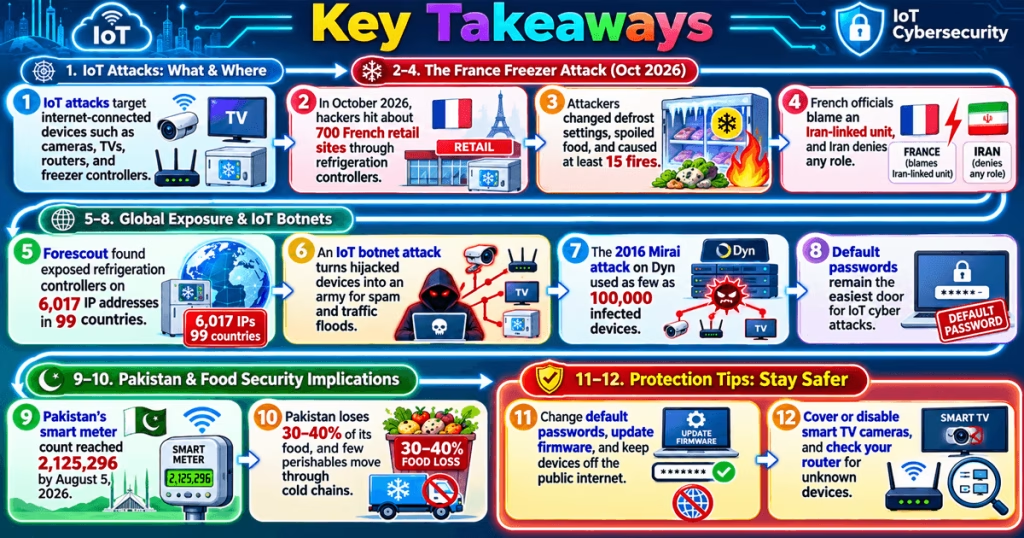
Key Takeaways
- IoT attacks target internet-connected devices such as cameras, TVs, routers, and freezer controllers.
- In October 2026, hackers hit about 700 French retail sites through refrigeration controllers.
- Attackers changed defrost settings, spoiled food, and caused at least 15 fires.
- French officials blame an Iran-linked unit, and Iran denies any role.
- Forescout found exposed refrigeration controllers on 6,017 IP addresses in 99 countries.
- An IoT botnet attack turns hijacked devices into an army for spam and traffic floods.
- The 2016 Mirai attack on Dyn used as few as 100,000 infected devices.
- Default passwords remain the easiest door for IoT cyber attacks.
- Pakistan’s smart meter count reached 2,125,296 by 5 August 2026.
- Pakistan loses 30–40% of its food, and few perishables move through cold chains.
- Change default passwords, update firmware, and keep devices off the public internet.
- Cover or turn off smart TV cameras, and check your router for unknown devices.
IoT Attacks in Cyber Security
IoT attacks are cyber attacks on internet-connected devices, such as cameras, TVs, and routers. Smart meters and freezer controllers count too. In essence, each device is a small computer that senses or controls something. Hackers break in to steal data, spy on users, or take control.
Cybersecurity teams treat these attacks as a core risk. One weak device can open up an entire network. Basically, every new connected device adds one more door to guard.
Who Is the Father of IoT?
Kevin Ashton coined the term “Internet of Things” in 1999. He used it as a presentation title at Procter & Gamble. In truth, Ashton wrote that he was only “fairly sure” of that origin. RFID Journal published his account in 2009. Many writers call him the father of IoT, though many labs built the field together.
Is AI Under IoT?
No, AI does not sit under IoT. The two are separate fields. IoT devices collect data from the real world, and AI studies it for patterns. In other words, IoT supplies the data, and AI supplies the insight. TechTarget calls the pairing AIoT, meaning AI built into IoT systems.
What Are Some Common IoT Devices Found at Home?
Homes now hold many smart gadgets. Common examples include smart TVs, security cameras, video doorbells, smart speakers, thermostats, and baby monitors. Routers, smart plugs, and smart bulbs count too. Altogether, IoT Analytics estimates 21.1 billion connected devices worldwide at the end of 2025. It expects about 39 billion by 2030.
Is a TV an IoT Device?
Yes, a smart TV counts as an IoT device. It joins your Wi-Fi, streams video, and runs apps. Most importantly, it runs software that needs updates, just like a phone. A basic TV with no network link does not count. The Federal Bureau of Investigation (FBI) warned in December 2019 that hackers can target smart TVs.
Attacks on IoT Devices
IoT cyber attacks are hostile acts that abuse connected devices. They range from spying through a camera to sabotaging a freezer controller. Common goals include stealing data, seizing control, or causing damage. Mirai and the French freezer hack are two examples.
Most IoT attacks follow a simple pattern. Hackers find a device on the internet, test a weak password, and take control. Subsequently, they turn it into a spy camera, a bot, or a doorway. A freezer controller can play any of these roles.
Why Would Hackers Target IoT Devices?
Hackers target IoT devices for simple reasons. Many ship with default or weak passwords, and owners rarely update the firmware. The devices also run 24/7 and have no warning screen. To emphasize, Mirai needed no software flaw. It guessed default logins such as admin/admin, Rapid7 explains.
Attackers also want what the device can do. A hijacked camera can spy, and a hijacked router can steal passwords. In particular, a hijacked freezer controller can spoil food and start a fire. A swarm of hijacked devices can also knock websites offline.
What Are the Most Common Types of IoT Attacks and How to Prevent Them?
The four most common IoT attacks are weak passwords, old firmware, exposed services, and botnet hijacking. In brief, each has a simple fix. The sections below pair each threat with its fix.
Common IoT Attacks and Their Fixes at a Glance
| Attack Type | How It Works | Best Fix |
| Weak and default passwords | Attackers try factory logins such as admin and root. | Set a unique password on day one. |
| Unpatched firmware | Old software carries known flaws. | Turn on automatic updates. |
| Internet-exposed services | Scanners list devices that answer on the open internet. | Close remote access, or use a VPN. |
| Device hijacking for botnets | Infected devices obey a control server. | Use strong passwords, keep software updated, and use a guest network. |
Weak and Default Password Attacks
Attackers try factory logins such as admin and root. Rapid7 documented this method in the Mirai botnet. Hence, a unique password is your first defense. Change every default login on day one. Never reuse a password, and use a password manager if you own many devices.
Unpatched Firmware Exploits
Old firmware carries known flaws. Attackers scan the internet for devices that never got the fix. Turn on automatic updates, or check the maker’s website each month. Besides, retire devices that the maker no longer supports.
Internet-Exposed Service Attacks
Search engines such as Shodan list devices that answer on the open internet. Forescout’s October 2026 study found refrigeration controllers on 6,017 IP addresses in 99 countries. Leave remote access on only if you truly need it. Put any remote access you keep behind a VPN or a firewall.
Device Hijacking for Botnets
Hackers link hijacked devices into a botnet. The owner may notice only a slow connection. At the same time, the botnet sends spam or floods a target with traffic. That is an IoT botnet attack in its simplest form. Unique passwords, updates, and a separate guest network block many of these attacks.
What Are the Common Types of Attacks Targeting Smart Home Devices?
Smart home attacks fall into five groups. Hackers hijack cameras and baby monitors to watch people. Others take over routers to steal data and passwords. In general, attackers also guess weak passwords on any gadget. Some spy through smart TV cameras and microphones. Others breach the maker’s cloud service, as the Verkada case showed.
Can Hackers Hack a Smart Fridge or Freezer?
Yes, in theory, hackers can reach a smart fridge. Cybernews says any internet-linked device can be a target. That includes devices that connect through an app, a cloud service, or a home network. In 2015, researchers at a Las Vegas hacking conference compromised a Samsung smart fridge. They intercepted some of its internet traffic. To point out the difference, the French attacks hit store refrigeration controllers, not home fridges. Both share one weakness: they connect to the internet.
Cybernews lists simple fixes. Change default passwords, and turn on two-factor authentication where offered. Update devices often, and replace any that no longer get security fixes. All in all, a smart fridge needs the same care as a router. Keep the rest of your devices on your local network.
Famous IoT Attacks
The famous IoT attacks below span 2015 to 2026. Above all, they show how much damage a small device can do. Each one began with a weak spot.
Famous IoT Attacks at a Glance
| Year | Attack | Devices Involved | What Happened |
| 2015 | Jeep Cherokee hack | Car infotainment system | Researchers remotely controlled a moving SUV. |
| 2016 | Mirai attack on Dyn | Cameras and other devices with default logins | Twitter, GitHub, and Pandora went offline. |
| 2018 report | Casino fish tank hack | Smart thermometer | Attackers reached a high-roller database. |
| 2020–2021 | Verkada camera breach | Cloud-based security cameras | A hacker reportedly reached more than 150,000 live cameras. |
| 2025 | Aisuru botnet attack | Home routers and cameras | A 15.72 Tbps flood hit one IP address in Australia. |
| 2026 | French freezer hack | Refrigeration controllers | About 700 retail sites suffered heat, spoilage, and fires. |
What Is the Most Harmful Attack Against IoT?
No single answer fits every case. Harm depends on what you measure. Mirai disrupted major websites across the internet. The 2015 Jeep hack put a driver at risk. On the other hand, the French freezer attack caused physical damage, fires, and spoiled food. French officials say it is the first cyber campaign on French soil aimed only at sabotage.
The Mirai IoT Botnet Attack on Dyn
On 21 October 2016, a Mirai botnet attacked Dyn, a domain name service provider. As a result, Twitter, GitHub, and Pandora went offline. Bitdefender reported that Dyn counted as few as 100,000 infected devices. Traffic peaked near 1.2 terabits per second.
Mirai did not exploit a software flaw. Rapid7 says Mirai “simply tries to guess Telnet login credentials” on devices open to the internet. Telnet is an old remote-access method. To illustrate, Rapid7 listed pairs such as admin/admin and root/root. That habit powered the Mirai IoT botnet attack on Dyn.
The Jeep Cherokee Hack
In July 2015, researchers Charlie Miller and Chris Valasek took remote control of a Jeep Cherokee. They exploited a flaw in its Uconnect infotainment system. Finally, they slowed the SUV from 70 mph until it stopped. Wired reporter Andy Greenberg was driving it. Fiat Chrysler recalled about 1.4 million vehicles after the demo.
The Casino Fish Tank Thermometer Hack
A casino lobby held a fish tank with a smart thermometer. Attackers used the thermometer as a foothold because it was connected to the casino network. They found the high-roller database. They sent it out through the thermometer to the cloud. Darktrace CEO Nicole Eagan shared the case publicly.
The Verkada Camera Breach
Verkada sells cloud-based security cameras. The US Federal Trade Commission (FTC) said hackers breached it at least twice. The breaches came between December 2020 and March 2021. During the March 2021 breach, a hacker reportedly reached more than 150,000 live cameras. The FTC said the hacker saw people inside psychiatric hospitals and women’s health clinics.
Password rules were weak, the FTC said, and encryption and network controls fell short too. Outside reviewers had warned about gaps, and Verkada allegedly left them open. Following those findings, the FTC announced a proposed settlement in August 2024. It carried a $2.95 million penalty. The order would also make Verkada run a security program with outside audits.
The Aisuru Botnet and the 15.72 Tbps Attack
On 24 October 2025, Microsoft Azure stopped a 15.72 Tbps attack. It targeted one public IP address in Australia. The Aisuru botnet launched it from more than 500,000 source IP addresses. Put differently, ordinary home gadgets powered a massive IoT botnet attack. Microsoft said the bots came mainly from home routers and cameras.
What Happened in the French Supermarket Freezer Hack?
How the French Supermarket Freezer Hack Unfolded?
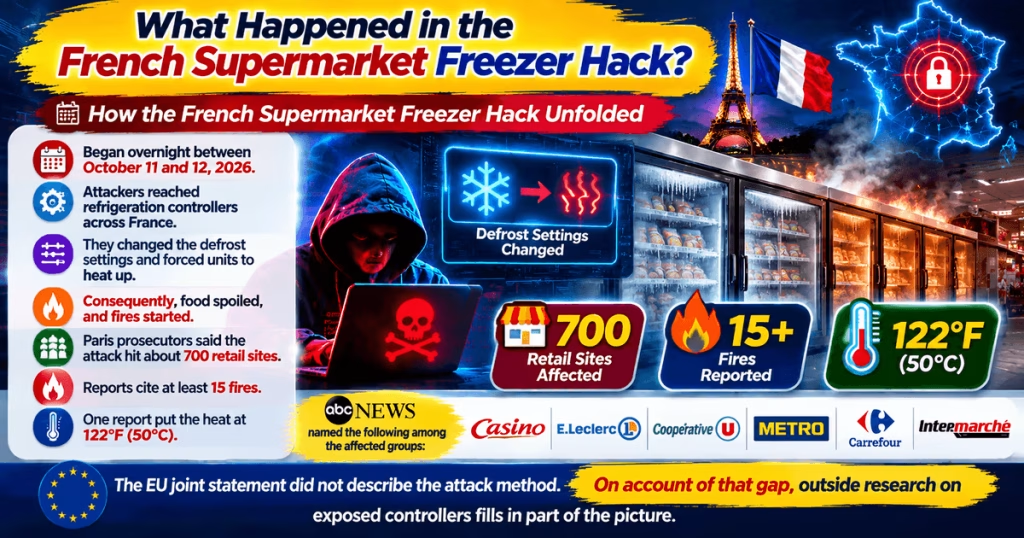
The French supermarket freezer hack began overnight between October 11 and 12, 2026. Attackers reached refrigeration controllers across France. They changed the defrost settings and forced units to heat up. As a result, food spoiled, and fires started. Paris prosecutors said the attack hit about 700 retail sites. Reports cite at least 15 fires. One report put the heat at 122°F (50°C).
ABC News named Casino, Leclerc, Coopérative U, Metro, Carrefour, and Intermarché among the affected groups. The EU joint statement did not describe the attack method. Because of that gap, outside research on exposed controllers helps fill in part of the picture.
French Supermarket Freezer Hack: Key Facts
| Fact | Event |
| October 11–12, 2026 | Attackers change refrigeration settings at about 700 French retail sites. |
| 22 October 2026 | Forescout publishes its exposure study of refrigeration controllers. |
| November 1–2, 2026 | A second wave hits more than 100 sites across Europe. |
| 4 November 2026 | EU bodies issue a joint statement, and pro-Russian groups claim the attacks. |
| 9 November 2026 | Paris prosecutors blame an Iran-linked unit, and Iran denies it. |
Why France Blamed Iran?
France pointed to Iran on 9 November 2026. Paris prosecutors explicitly said the attack served a foreign power, Iran. They named Shahid Kaveh, a cyber unit linked to Iran’s Revolutionary Guard.
Foreign Minister Jean-Noël Barrot called the attack
unprecedented in its level of aggression.
Iran denies any role. Its Foreign Ministry rejected the accusations as
baseless and biased.
Attribution in cyber cases often rests on evidence outsiders cannot see. To clarify, an official claim is not a court ruling. Readers should wait for open evidence and independent reviews.
Pro-Russian Claims and a Suspected Controller Botnet
Not everyone agrees on the culprit. France blames Iran for the attack on the supermarkets. Conversely, the pro-Russian groups NoName057(16) and Z-Pentest claimed the attacks on 4 November. Those claims remain unconfirmed. A December 2025 joint advisory called such groups less skilled than state hackers.
SecurityScorecard’s STRIKE team found a suspected spam botnet on hijacked Copeland XWEB PRO controllers. It gave the finding low-to-medium confidence. Nonetheless, the finding suggests that outsiders can abuse these controllers. STRIKE has not linked the botnet to the French attacks.
The Second Wave and the EU Response
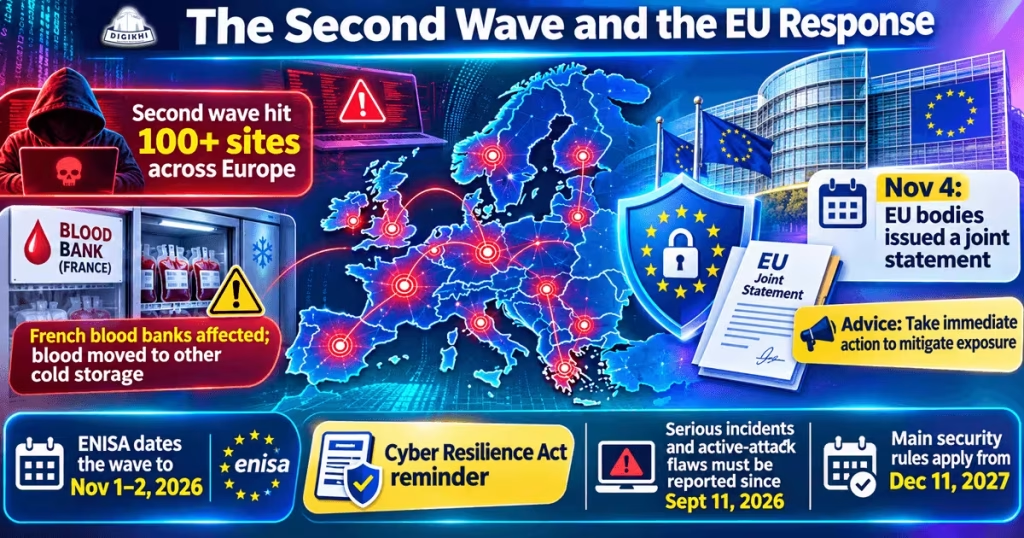
ABC News reported a second wave that struck more than 100 sites across Europe. Additionally, French blood banks suffered, and staff moved some blood to other cold storage. ENISA, the EU cybersecurity agency, dates this wave to November 1 and 2, 2026.
On 4 November, EU bodies issued a joint statement on the attacks. It advises organizations to “take immediate action to mitigate exposure in the affected systems.” Furthermore, it reminded manufacturers of the Cyber Resilience Act. Since 11 September 2026, they must report serious incidents and flaws under active attack. The main security rules apply from 11 December 2027.
Critical Infrastructure Cyberattacks in Europe, the US, and Canada
Critical infrastructure cyberattacks did not stop in France. Bloomberg reported that Moscow-linked hackers now target water plants, factories, and food firms. Overall, the report describes a shift from website attacks to physical damage. Pipes burst, food spoiled, and fires started. Meduza summarized the report on 28 October 2026.
How IoT Cyber Attacks Reach Power, Water, and Food Systems?
A joint advisory describes the entry point. It came from the FBI, the Cybersecurity and Infrastructure Security Agency (CISA), NSA, and partners. Evidently, attackers need no software flaw. They reach operator panels, called HMIs, through remote-viewing tools. Those panels often have “default, weak, or no passwords.”
Inside the panel, attackers can rewrite setpoints, alarm limits, and passwords. To explain, a setpoint is a target value, such as a freezer temperature. Red Tiger Security describes how this access can cause physical damage. These industrial devices share the weak points of home gadgets.
Reported damage spans several countries. In Spain, crematorium ovens stopped, and a factory fire broke out. Further, about 450 homes in Tureby, Denmark, lost water in December 2024. In 2024, attackers reportedly switched off the cooling at a meat plant near Los Angeles. More than 2,000 pounds of meat spoiled. US and Canadian agencies publish defensive advice. CISA offers guidance on securing industrial control systems. For small teams, Canada’s Cyber Center publishes baseline controls.
Cyber Sabotage: Why Attackers Choose Heat, Water, and Cold
Cyber sabotage means damaging systems, not stealing data. Heat, water, and cold make easy targets. In the final analysis, a few degrees can ruin food or medical supplies. Critical infrastructure cyberattacks often follow this playbook.
CISA, as Meduza quotes it, calls these groups opportunistic. It says they hit whatever they can reach. However, a weak device does not need a clever attacker. CISA also says such groups often exaggerate their impact.
Asymmetric Warfare and the NATO Article 5 Question
Asymmetric warfare lets a weaker actor hurt a stronger one at low cost. Put differently, a cheap scan and a default password can do the work of a weapon. This article uses IoT warfare for attacks that turn connected devices into weapons.
At the 2014 Wales summit, allies said cyber attacks could justify invoking Article 5. In 2021, NATO updated its policy. It said the cumulative effect of serious malicious cyber activity might amount to an armed attack. Presently, the North Atlantic Council decides each case on its facts. No automatic trigger exists.
Why States Prefer Low-Cost Cyber Sabotage?
States use many tools in modern conflict. Cyber sabotage costs little and leaves room for denial. Although a missile strike carries clear fingerprints, a hacked controller does not. French officials said Iran’s units hid behind fronts called “CyberAveng3rs” and “Cyber Isnaad Front.” Iran denies the accusation.
Smart Grid Cybersecurity in Pakistan and the Gulf
Pakistan is adding connected equipment fast. Utilities, shops, and homes all join the network. With new meters, SCADA links, and cold rooms, the number of entry points is growing. Smart grid cybersecurity in Pakistan therefore matters today. IoT cyber attacks can hit meters, cold rooms, and control rooms alike.
K-Electric SCADA Security
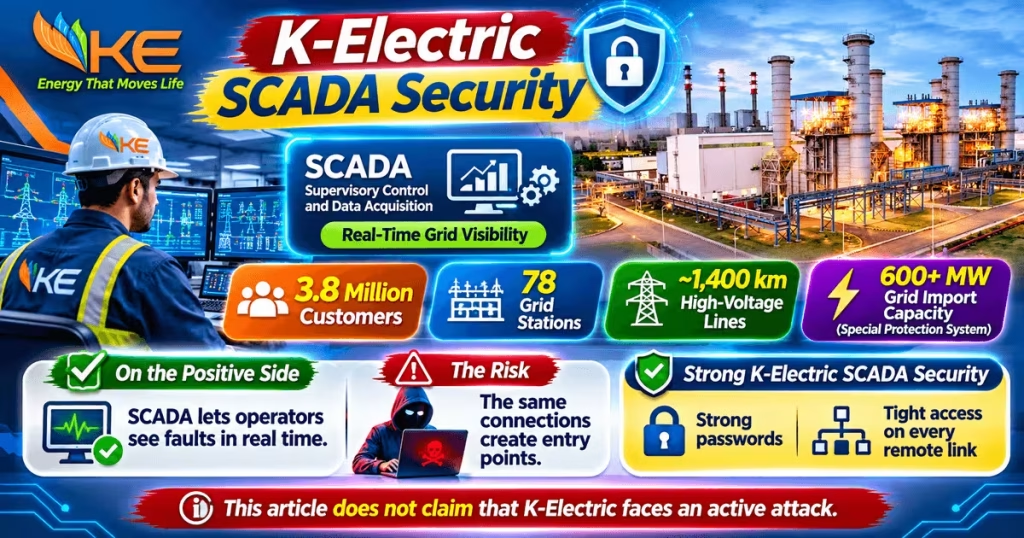
K-Electric serves 3.8 million customers, POWER Magazine reports. To demonstrate its scale, the utility runs 78 grid stations. Its high-voltage lines stretch nearly 1,400 kilometers. SCADA, short for supervisory control and data acquisition, gives operators real-time visibility.
A Special Protection System added more than 600 MW of grid import capacity. On the positive side, SCADA lets operators see faults in real time. The same connections create entry points. Strong K-Electric SCADA security means strong passwords and tight access on every remote link. This article does not claim that K-Electric faces an active attack.
Smart Meters and the Growing Attack Surface
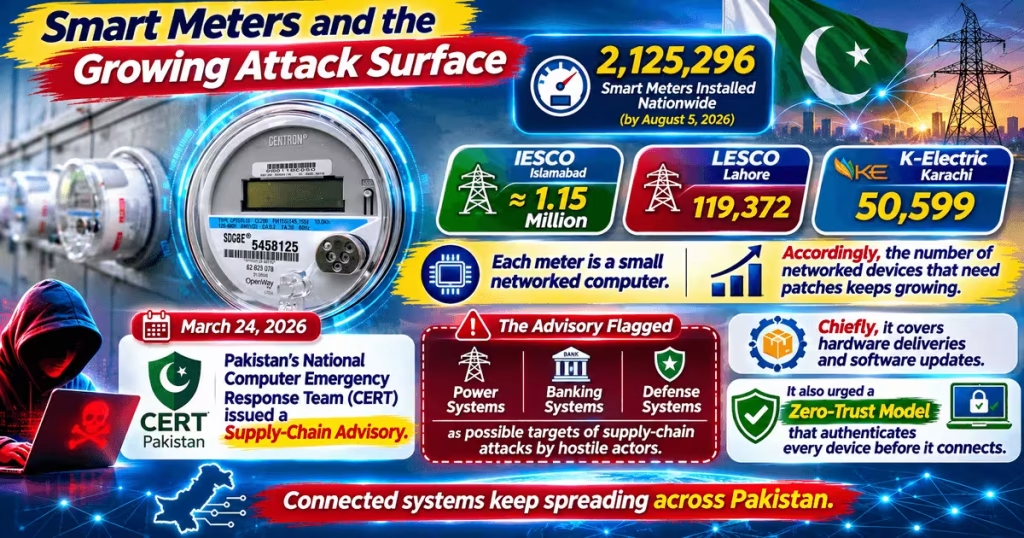
The Associated Press of Pakistan reported that 2,125,296 smart meters were installed nationwide by 5 August 2026. Islamabad’s IESCO had about 1.15 million, Lahore’s LESCO had 119,372, and K-Electric had 50,599. Accordingly, the number of networked devices that need patches keeps growing. Each meter is a small networked computer.
On 24 March 2026, Pakistan’s National Computer Emergency Response Team (CERT) issued a supply-chain advisory. It flagged power, banking, and defense systems as possible targets of supply-chain attacks by hostile actors. Chiefly, it covers hardware deliveries and software updates. It also urged a zero-trust model that authenticates every device before it connects.
Connected systems keep spreading across Pakistan. DigiKhi tracks these risks, from state-sponsored spyware and digital threats to satellite and next-gen telecom security. Concurrently, AI-driven infrastructure in Karachi adds more networked devices to protect.
Cold Chains, Food Loss, and Gulf Exposure
Dawn estimates that 30 to 40 percent of Pakistan’s food output goes to waste each year. Most of that loss happens after harvest and in transport. Under 6% of perishables travel through temperature-controlled supply chains. After all, every new cold room brings controllers, sensors, and remote panels. New cold rooms should start with secure settings.
The Gulf has its own exposure. The Gulf Cooperation Council (GCC) imports up to 85% of its food. Transport & Logistics Middle East reported that figure in October 2025. Generally, cold chains keep that food safe. Their controllers deserve the same security as any key system.
How Does an IoT Botnet Attack Work?
An IoT botnet attack is a coordinated attack by many hijacked connected devices. Criminals control these devices, called bots, from one server. Put another way, thousands of gadgets work for a stranger. The bots then send spam or flood a target with traffic.
The process starts with a scan. The botnet probes the internet for reachable devices. Eventually, it finds a device with a weak login. Mirai did exactly that with default logins. It then installs malware on the device.
The infected device waits for orders from a control server. The botnet owner can launch spam, traffic floods, or proxy traffic. By comparison, Aisuru’s 15.72 Tbps attack dwarfs Mirai’s 1.2 Tbps peak. Both IoT attacks relied on everyday devices.
How to Protect Smart Home Devices From IoT Attacks?
Home users can block the easiest IoT attacks in one afternoon. Start with devices that see or hear you, especially cameras and TVs. The FTC, FBI, and CISA agree on the basics. The five answers below cover detection, cameras, TVs, daily habits, and new devices.
Quick Home Defense Checklist
| Device | Do This First | Why It Matters |
| Router | Change the default admin login, and turn on encryption. | Every smart device depends on it. |
| Cameras | Set a unique password, and turn on two-factor authentication. | Cameras show your private life. |
| Smart TV | Learn the security settings, and cover an unused camera. | The FBI warned that hackers can reach TV cameras. |
| New device | Update the firmware, and use the guest network. | New gadgets often ship with weak settings. |
| Old gadgets | Unplug devices you no longer use. | Unused devices can stay online and unpatched. |
How to Detect Unauthorized Access Attempts on IoT Devices at Home?
Check your router’s device list for unfamiliar names. Open its settings page and find the list of devices on your network. To enumerate them, compare each name with the gadgets you own. Menu names vary by router. Any unknown name deserves a closer look.
Check your camera logs, too. Strange IP addresses or logins at odd hours are warning signs, the FTC says. At the same time, watch for odd behavior. The FBI says hackers can change TV channels or volume. If something looks wrong, change the password and remove the unknown device.
How Can I Protect My Internet-Connected Cameras From Unauthorized Access?
Change the default username and password on day one. Equally, never reuse a password from your other accounts. Turn on two-factor authentication if the camera offers it. Cameras show your private life, so they deserve extra care.
Keep the firmware and the camera app updated. Turn off remote management if you do not use it. Another lesson comes from Verkada. The FTC alleged weak password rules and poor encryption at that company. Choose camera makers that publish updates and treat security as a core feature.
Can Someone Watch Me Through My Smart TV?
Yes, someone can watch you through some smart TVs. The FBI warned in December 2019 that hackers could reach a TV’s camera and microphone. In the worst case, attackers can cyberstalk you. Nevertheless, not every model has a camera. Check your model’s specifications.
The FBI offers simple steps. Learn your TV’s security settings, and change the default network password. Learn how to turn the camera and microphone on and off. If the camera has no off switch, cover it with black tape. Of course, tape does not stop the microphone. The FTC also advises reviewing tracking settings and removing apps you do not use.
What Are the Best Security Practices for Protecting Smart Home IoT Devices?
Five habits cut your risk. Change every default password, and never reuse one. Henceforth, update device firmware and companion apps as soon as updates arrive. Turn off features you do not use, such as remote management. Unplug old gadgets you no longer use.
Secure your router first, since every device depends on it. Change its default admin login, and turn on wireless encryption. Check for router updates often. CISA warns that malware can slip past a router’s firewall through UPnP, a setup feature. Turn it off unless you need it. Many routers also offer a guest network. Put smart gadgets there.
What Are the Best Practices for Securing New IoT Devices Before Connecting Them to a Home Network?
Research before you buy. A good brand explains how long it will send security updates. The US Cyber Trust Mark may help soon. It is a voluntary label that works like Energy Star. So far, no labeled products have reached store shelves. Commissioner Olivia Trusty of the Federal Communications Commission hopes they will arrive within a year. Nextgov reported this in October 2026.
Set up each new device with care. Create a unique password at the first screen. Turn off remote access and any features you don’t need. Before testing the device, place it on the guest network instead of your main Wi-Fi. Update the firmware right away.
How to Defend Business Devices Against IoT Cyber Attacks?
Business owners need a clear plan. Many cold rooms run on a handful of controllers. Firstly, list every connected controller, camera, and sensor. Note each model, firmware version, and location. You cannot protect a device you do not know about.
Check each controller’s remote access. Forthwith, remove any panel that faces the public internet. Reach controllers through a VPN or a firewall instead. Change every factory login.
Keep refrigeration controls on their own network, away from office computers and guest Wi-Fi. Add an independent temperature alarm with its own power and network link. At this point, staff still learn about a heat spike if an attacker hides it. Replace products that the maker no longer supports.
What to Do If You Suspect an IoT Cyber Attack?
Act fast if a device behaves strangely. Disconnect it from the network. Change the passwords on the device, the router, and linked accounts. A factory reset can clean a home gadget, but update the firmware before you reconnect it. Businesses should also call the vendor and their national CERT. Keep a record of times and settings.
Stop IoT Attacks Before They Start
IoT attacks turned ordinary freezers into targets in October 2026. The French supermarket freezer hack shows that a hijacked controller can spoil food and start fires. In conclusion, basic security is everyone’s job, from home users to grid operators. Weak default passwords fueled the Mirai IoT botnet attack, and they still matter.
For more updates, Latest News, and Digital Marketing Services, email us at contact@digikhi.com. Or visit our website (https://www.digikhi.com).
Source
- RFID Journal – That ‘Internet of Things’ Thing (Kevin Ashton, 2009) – https://www.rfidjournal.com/that-internet-of-things-thing
- IoT Business News – State of IoT 2025 (IoT Analytics estimate) – https://iotbusinessnews.com/?p=44499
- TechTarget – Artificial Intelligence of Things (AIoT) – https://www.techtarget.com/iotagenda/definition/Artificial-Intelligence-of-Things-AIoT
- CBS News New York – FBI warning about smart TVs (December 2019) – https://www.cbsnews.com/amp/newyork/news/hackers-smart-tv-spy-on-you-fbi/
- FBI Portland – Tech Tuesday: Smart TVs (linked by the CBS report) – https://www.fbi.gov/contact-us/field-offices/portland/news/press-releases/tech-tuesdaysmart-tvs
- FTC Consumer Advice – Securing your internet-connected devices at home – https://consumer.ftc.gov/node/77454
- CISA – Home Network Security – https://www.cisa.gov/tips/st15-002
- Rapid7 – Mirai FAQ: When IoT Attacks – https://www.rapid7.com/blog/post/2016/10/25/mirai-faq-when-iot-attacks/
- Bitdefender – DNS DDoS attacks caused by 100,000 Mirai-infected devices – https://www.bitdefender.com/en-us/blog/hotforsecurity/dns-ddos-attacks-caused-by-100000-mirai-infected-devices
- Dark Reading – Chrysler recalls 1.4 million vehicles after Jeep hacking demo – https://www.darkreading.com/vulnerabilities—threats/chrysler-recalls-14-million-vehicles-after-jeep-hacking-demo-/d/d-id/1321463
- Security Affairs – Attackers exfiltrated a casino’s high-roller list through a connected fish tank – https://securityaffairs.com/71433/hacking/fish-tank-hack.html
- Hunton Andrews Kurth – FTC announces proposed settlement with security camera firm (Verkada) – https://www.hunton.com/privacy-and-cybersecurity-law-blog/ftc-announces-proposed-settlement-with-security-camera-firm-over-alleged-data-security-failures-and-can-spam-violations
- Microsoft Azure Infrastructure Blog – 15.72 Tbps DDoS attack (Aisuru) – https://techcommunity.microsoft.com/blog/azureinfrastructureblog/-/4470422
- CBS News – France blames Iran for refrigerator and freezer hack – https://www.cbsnews.com/news/france-iran-behind-refrigerator-freezer-hack-cyberattack/
- ABC News – Unprecedented cyberattacks on refrigerators in France – https://abcnews.com/International/unprecedented-cyberattacks-refrigerators-france/story?id=138028066
- GovTech – How hot did supermarket freezers get after they were hacked? – https://www.govtech.com/question-of-the-day/how-hot-did-supermarket-freezers-get-after-they-were-hacked
- Al Jazeera – What is Shahid Kaveh, the Iran cyber unit tied to France’s fridge hacking? – https://www.aljazeera.com/news/2026/11/10/what-is-shahid-kaveh-%E2%81%A0the-iran-cyber-unit-tied-to-frances-fridge-hacking
- ENISA – Joint statement on cybersecurity incidents affecting commercial refrigeration systems (4 November 2026) – https://www.enisa.europa.eu/node/19616
- Zscaler – The fix has been out for a year, but the controller is still exposed – https://www.zscaler.com/blogs/product-insights/fix-has-been-out-year-controller-still-exposed
- Forescout Vedere Labs – Cold chain, open control: exposed refrigeration systems – https://www.forescout.com/blog/cold-chain-open-control-exposed-refrigeration-systems-reveal-global-risk/
- Help Net Security – Copeland XWEB refrigeration controllers in a spam botnet – https://www.helpnetsecurity.com/2026/11/09/copeland-xweb-refrigeration-controllers-spam-botnet/
- Red Tiger Security – Pro-Russia hacktivists, HMIs, and physical damage – https://www.redtigersecurity.com/advisory/pro-russia-hacktivists-hmi-physical-damage
- Meduza – Russia-linked hackers exploit poorly secured industrial systems (summarizing Bloomberg) – https://meduza.io/en/feature/2026/10/28/russia-linked-hackers-are-exploiting-poorly-secured-industrial-systems-to-sabotage-factories-utilities-and-food-production-across-the-west-bloomberg-reports
- CISA – Industrial Control Systems – https://www.cisa.gov/topics/industrial-control-systems
- Canadian Center for Cyber Security – Baseline cyber security controls for small and medium organizations – https://www.cyber.gc.ca/en/guidance/baseline-cyber-security-controls-small-and-medium-organizations
- NATO – Cyber defense – https://www.nato.int/cps/en/natohq/topics_78170.htm
- POWER Magazine – Doubling down on reliability: Karachi’s engineered smart grid breakthrough – https://www.powermag.com/doubling-down-on-reliability-karachis-engineered-smart-grid-breakthrough/
- APP – Over 2.12 million smart meters installed nationwide – https://app.com.pk/national/over-2-12m-smart-meters-installed-nationwide-to-curb-power-theft
- Dawn – National CERT supply chain advisory (24 March 2026) – https://www.dawn.com/news/1984857
- Dawn – Corporate window: fixing Pakistan’s food loss crisis – https://www.dawn.com/news/1949950/corporate-window-fixing-pakistans-food-loss-crises
- Transport & Logistics Middle East – Keeping it cool: cold chain logistics and food waste in the GCC – https://www.transportandlogisticsme.com/smart-logistics/keeping-it-cool-how-cold-chain-logistics-could-slash-food-waste-in-the-gcc
- Nextgov – FCC commissioner hopes Cyber Trust Mark products reach shoppers within a year – https://www.nextgov.com/cybersecurity/2026/10/fcc-commissioner-hopes-cyber-trust-mark-products-reach-shoppers-within-year/416878/
- Cybernews – Explainer: Could hackers get inside my fridge? – https://cybernews.com/security/explainer-could-hackers-get-inside-my-fridge/
- DigiKhi – Israeli spyware: Pakistan second most exposed – https://digikhi.com/israeli-spyware-adfection-pakistan-second-most-exposed/
- DigiKhi – Starlink satellite internet in Pakistan: safe or threat? – https://digikhi.com/starlink-satellite-internet-pakistan-safe-or-threat/
- DigiKhi – Karachi traffic news: AI traffic enforcement system – https://digikhi.com/karachi-traffic-news-update-for-ai-traffic-enforcement-system/
Disclaimer: This article gives general information, not legal or professional security advice. Officials and researchers make the attribution claims, and some remain disputed. Given the fast-moving nature of these events, details may change after publication. Readers should check the linked sources and consult a qualified expert before they act.





Related Articles

Starlink Satellite Internet Pakistan: Safe or Threat?
Is Starlink Internet Pakistan safe or a threat? Learn the licensing status,...
Israeli Spyware AdFection: Pakistan Second Most Exposed
Pakistan ranks second for exposure to Israeli spyware ads. Learn how AdFection...

Zong 5G Z HomeFi FWA Home Broadband Service Launched
Zong 5G now offers Z HomeFi home internet in Pakistan. See Zong...


Tecno Camon 50 Ultra 5G with Sony LYTIA 700C Night Camera
Tecno Camon 50 Ultra 5G with Sony LYTIA 700C Night Camera —...
