





Rainwater Harvesting: Pakistan’s 1st Jamali Sponge Park
 Shahid ZahidNovember 15, 202619 Mins read
Rainwater Harvesting meets Urban Flooding Solutions in a Sponge Park; Shahid Zahid tracks Biodiversity Conservation in Pakistan.
Your tank runs empty in May. The tanker arrives late, and the price keeps climbing. Then one short storm turns your street into a river. At the same time, a lot of free water rushes into drains and out to sea. You pay for water, and you pay for flood damage. That feels unfair. You can catch some of that rain yourself.
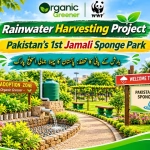
Rainwater harvesting gives you that control. A gutter, a filter, and a tank can store roof water for chores and gardens. Karachi also has a bigger example now. In November 2026, Gulberg Town opened Jamali Park, Pakistan’s first water-sensitive sponge park, per Dawn. Credit goes to Gulberg Town, WWF-Pakistan, and Organic Greener, which says it developed the park. The park soaks up stormwater, cleans it, and stores some of it underground. Above all, it shows that neighborhoods can act before the next monsoon. This guide explains how the park works and why it matters for biodiversity conservation in Pakistan. It also covers home setup, costs, and downsides.
Key Takeaways
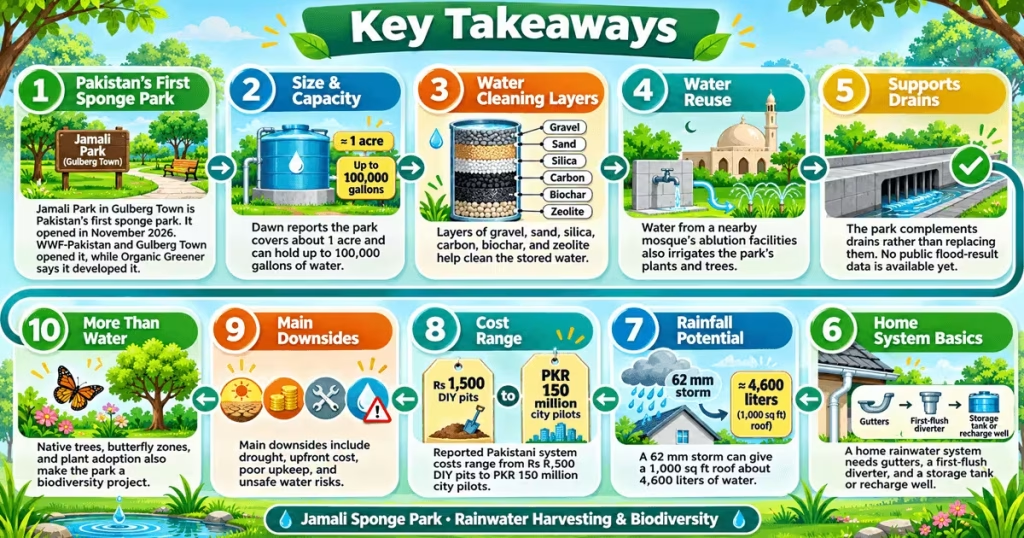
• Jamali Park in Gulberg Town is Pakistan’s first sponge park, opened in November 2026. WWF-Pakistan and Gulberg Town opened it, and Organic Greener says it developed it.
• Dawn reports the park covers about one acre and can hold up to 100,000 gallons.
• Layers of gravel, sand, silica, carbon, biochar, and zeolite clean the stored water.
• Water from a nearby mosque’s ablution facilities also irrigates the park’s plants and trees.
• The park complements drains rather than replacing them. No flood results are public yet.
• A home system needs gutters, a first-flush diverter, and a tank or recharge well.
• One 62 mm storm can give a 1,000 sq ft roof about 4,600 liters.
• Reported Pakistani system prices range from Rs 1,500 DIY pits to PKR 150 million city pilots.
• Drought, upfront cost, poor upkeep, and unsafe water are the main downsides.
• Native trees, butterfly zones, and plant adoption also make the park a biodiversity project.
A Quick Look at Jamali Sponge Park
| Detail | What Reports Say | Source |
| Park name | Jamali Park, in Gulberg Town, Karachi | Dawn, Tribune |
| Status | Opened in November 2026 as Pakistan’s first sponge park | Dawn, Tribune |
| Address | Gulberg Block 2 (Tribune) or Federal B Area, Block 8 (Dawn) | Tribune, Dawn |
| Size | About one acre | Dawn |
| Storage | Up to 100,000 gallons in monsoon events, per WWF experts | Dawn |
| Partners | Gulberg Town Municipal Corporation and WWF-Pakistan; Dawn also lists GSK | Dawn, Tribune |
| Developer claim | Organic Greener says it developed the park | Organic Greener, LinkedIn, 13 November 2026 |
| Cost and flood results | Not published yet | Dawn, Tribune |
Rainwater Harvesting Basics: Why Pakistan Needs Every Drop
Rainwater harvesting is catching rain where it falls and storing it for later use. Homes use roof tanks or recharge wells, and parks use basins. One millimeter of rain on one square meter of roof gives one liter. In other words, a 93-square-meter roof collects up to 93 liters for every millimeter of rain. You can store that water in a tank. You can also send it underground through a recharge well.
Pakistan needs that water. PCRWR says per capita supply fell below the 1,000-cubic-meter scarcity line in 2010. Business Recorder adds that farms use 96 percent of river water. Consequently, cities have less water to share. WWF-Pakistan describes Karachi’s daily water shortfall as more than 500 million gallons.
Why Karachi Gets Too Little Rain and Too Much at Once?
Karachi’s average yearly rainfall is about 200 millimeters, says a 2012 Express Tribune report. It also noted 62 millimeters falling between 5 p.m. and 8 p.m. one day in September. Drains can’t handle bursts like that. As a result, water pools on streets and rushes toward the sea.
The 2026 monsoon swung the other way. The Express Tribune cited Pakistan Meteorological Department data for July to September. Karachi’s rain ran 92 percent below normal. Sindh as a whole fell 50.8 percent short, and the department blamed El Niño. A dry year makes stored water particularly valuable. Our report on the Super El Niño threat in 2026 covers the weather background.
Urban Flooding Solutions: Why Concrete Alone Falls Short?
Concrete moves water fast, but it doesn’t keep it. Rain lands on Karachi’s roads and pavements. Dawn reports that much of it then flows to drains and the sea. Dialogue Earth further blames hard surfaces, encroached waterways, and aging drains for city floods. Drains still matter. They just can’t carry the whole load.
Urban flooding solutions are tools that slow, store, or move stormwater. Drains, rain gardens, recharge wells, and sponge parks all count. Sponge parks add a second layer. Instead of rushing water away, they hold it for a while. Soil and plants then absorb some of it. Tribune reports that the Jamali Park system aims to slow runoff and ease pressure on drains. Most importantly, the report says the park complements conventional drainage. It doesn’t replace it.
Earlier Karachi Efforts: Wells and Recharge Pits
Karachi has tried related ideas before. In July 2023, Mayor Murtaza Wahab said Karachi had revived two old wells at Burns Garden. He argued that wells could raise groundwater levels and help prevent flooding. Following that, he said the city planned more wells in other parks. Polo Ground at Baradari was one planned site, according to Geo News.
Citizens have tried it too. In North Karachi, Aman Khan Kakakhel piped street water into dried-up park wells. The Express Tribune reported his claim of up to 3 million gallons in 2022. Nevertheless, those figures are his own claims, and the paper did not verify them.
How the Sponge City Idea Began?
The sponge idea did not start in Karachi. Tribune notes that China launched a national sponge city program in 2014. It cites Wuhan and Shanghai. Copenhagen built a cloudburst plan after severe rain in 2011. Additionally, Tribune names Rotterdam’s water squares and Singapore’s Active, Beautiful, Clean Waters program.
Sponge Park Basics: How a Sponge Park Works
A sponge park is a planted public space that soaks up, cleans, and slowly releases rain. It uses shallow basins, porous soil, and native plants to cut runoff and refill groundwater. Citizen Matters describes these parks as built wetlands. Builders also add channels to steer water in and out. Generally, sandy and sandy-loam soils suit them best. Clay and rocky ground limit where these parks can go.
Jamali Sponge Park: Pakistan’s First Sponge Park in Karachi
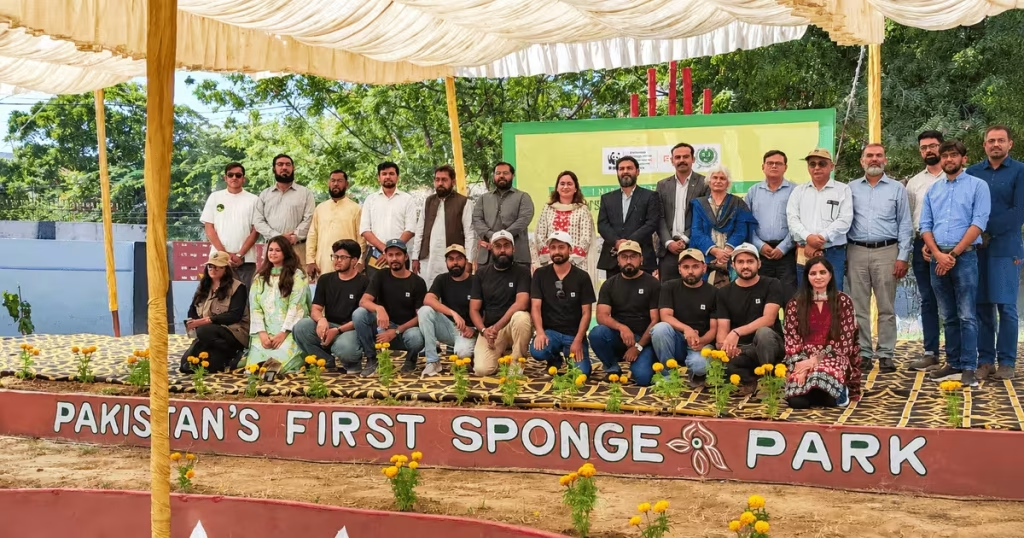
Gulberg Town Municipal Corporation and WWF-Pakistan opened Jamali Park in November 2026. Dawn lists GSK as a third partner, while Tribune mentions an unnamed private partner. The project took six months. Dawn reports the site covers about one acre. In particular, WWF experts say the park can hold up to 100,000 gallons in monsoon events. Dawn doesn’t say whether that figure covers one storm or a full season.
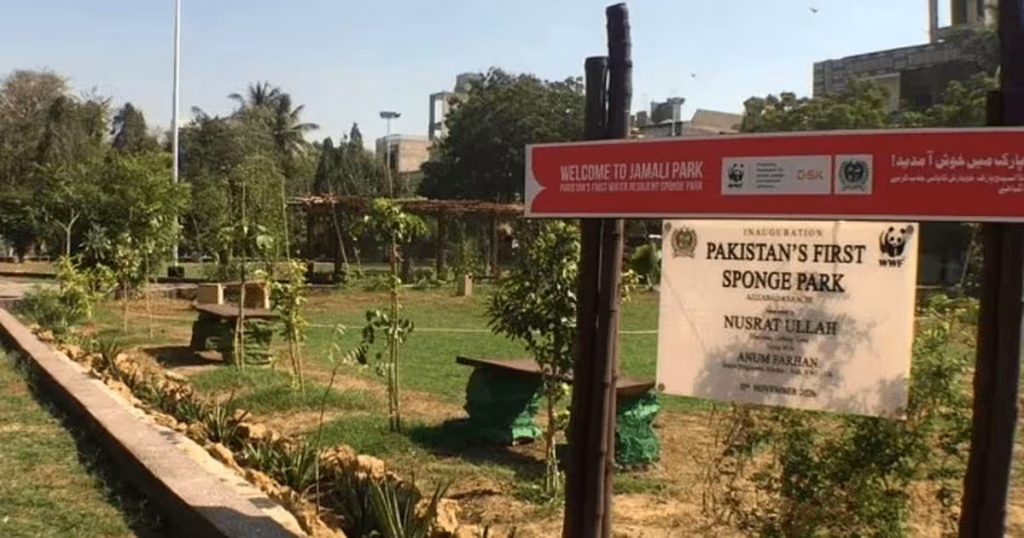
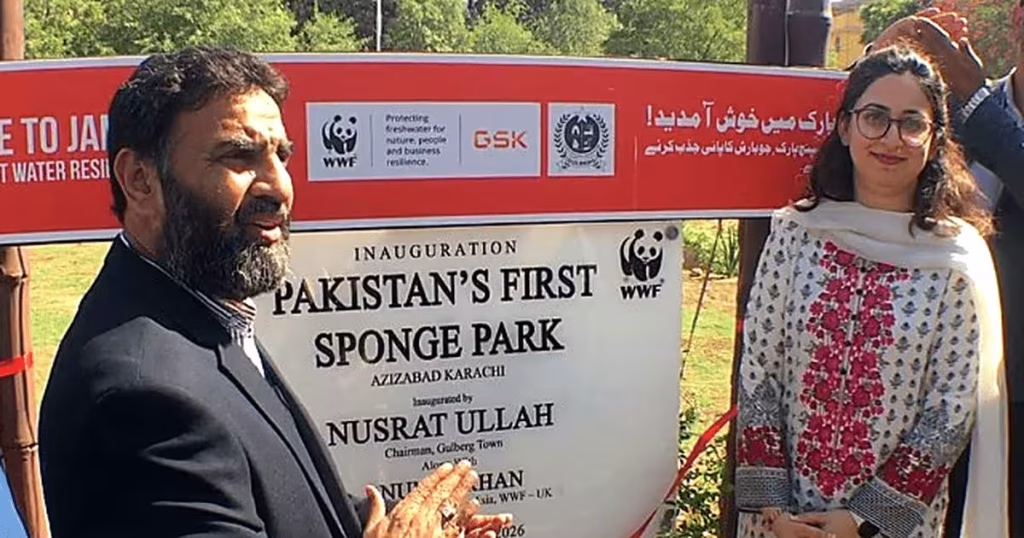
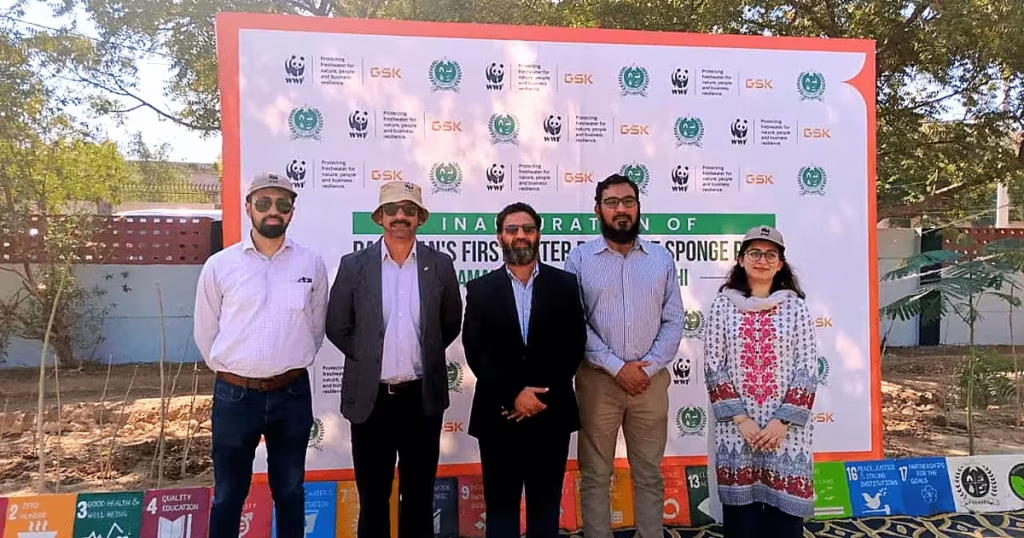
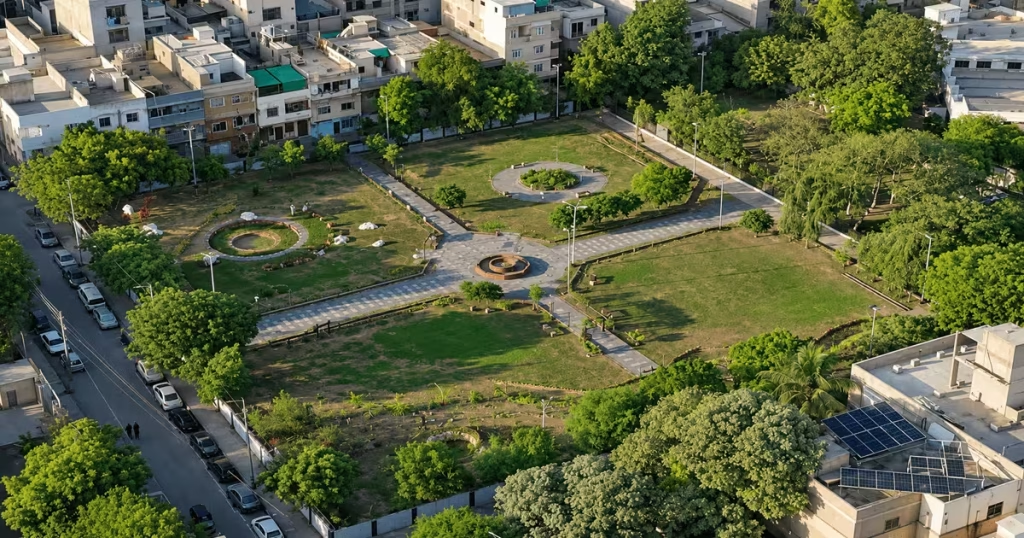
Reports disagree on the exact address. Tribune places Jamali Park in Gulberg Block 2. Dawn lists Federal B Area, Block 8, in Gulberg Town. To clarify, both outlets agree on the town and the park’s name. Confirm the address with the Gulberg Town office before you visit. But according to Google Maps, it is in Block 8, Gulberg Town.
WWF-Pakistan’s Role in the Jamali Sponge Park
Both Dawn and Tribune name WWF-Pakistan as a partner. Its Building Water-Sensitive Societies program runs from 2025 to 2029 with GSK. The program starts in Karachi and Lahore. Its web page presently lists sponge cities, recharge wells, and mosque water reuse as core work. WWF experts also supplied the 100,000-gallon figure that Dawn reports. I found no WWF-Pakistan statement on Jamali Park itself.
Organic Greener’s Role in the Jamali Sponge Park
Organic Greener says it developed the park with WWF-Pakistan and TMC Gulberg. The Karachi company announced the opening on LinkedIn on 13 November 2026. It calls the project a working example of nature-based solutions. It also thanked both partners for their support. We credit its team for the work it describes. The Dawn and Tribune reports I reviewed do not name Organic Greener. This credit comes from the company itself.


The company says the site collects rain and lets it soak into the ground. That should cut runoff and help refill groundwater. It also cites permeable paths and green areas. Correspondingly, it points to learning spaces that teach climate, wildlife, waste, and sustainability topics. These are the company’s own claims, not test results.
Underground Filter Layers That Clean Stored Water
Locally made filters sit below the channels that carry rain. Tribune names six materials, and each does one job. Gravel and coarse stones stop leaves and dirt. Sand and silica catch the finer grit. Activated carbon and biochar pull out chemical and organic waste. Moreover, Zeolite helps remove some heavy metals and other pollutants. The cleaned water then moves into underground storage or tanks. The reports share no water test results.
Mosque Ablution Water Reuse for Irrigation
The park also captures water from a nearby mosque’s ablution (wudu) facilities. Filters clean that water before it irrigates the park’s plants and trees.

The aim is to reduce the park’s fresh water use for plant care, given scarcity. WWF-Pakistan lists ablution water reuse in mosques among its water projects in Karachi and Lahore. Reports don’t name the mosque or say how much water it supplies.
Rain Gardens, Bioswales, and Permeable Pathways
Dawn lists three working above-ground components. Rain gardens are shallow planted areas that hold runoff briefly and help recharge groundwater.
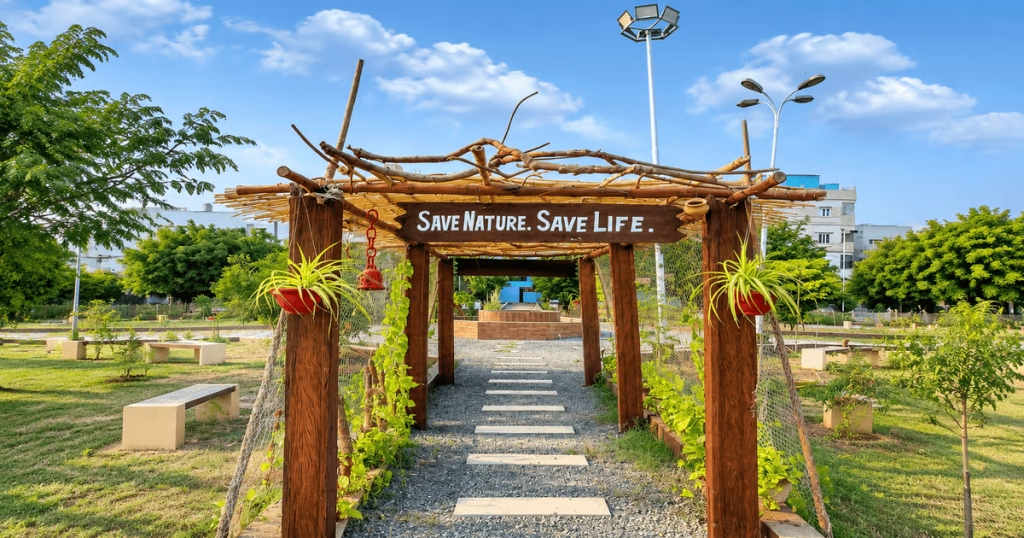
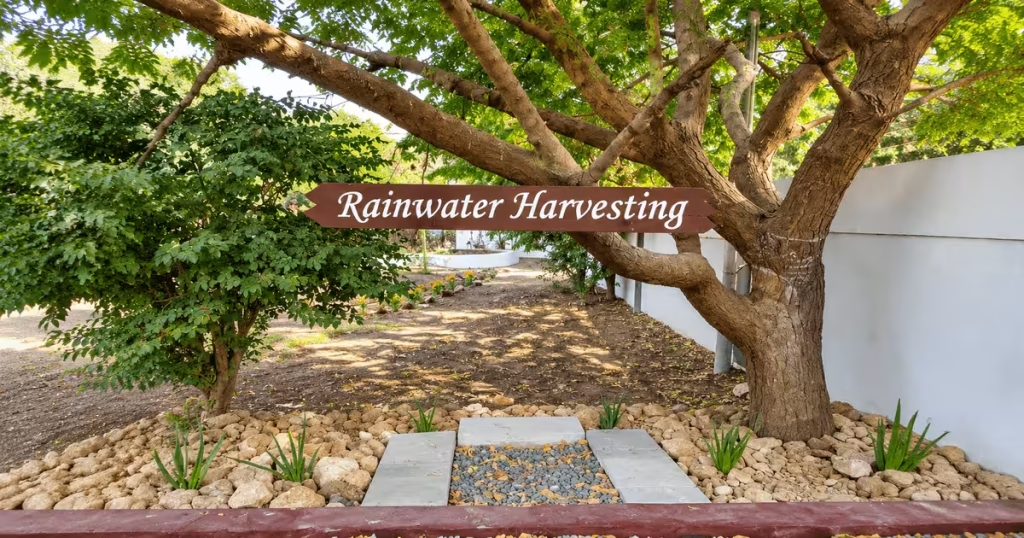
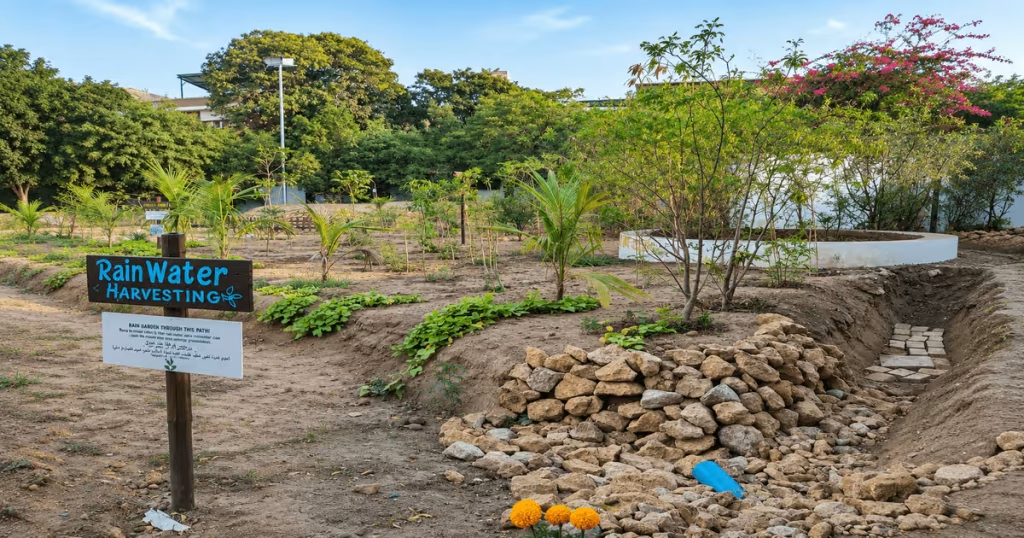
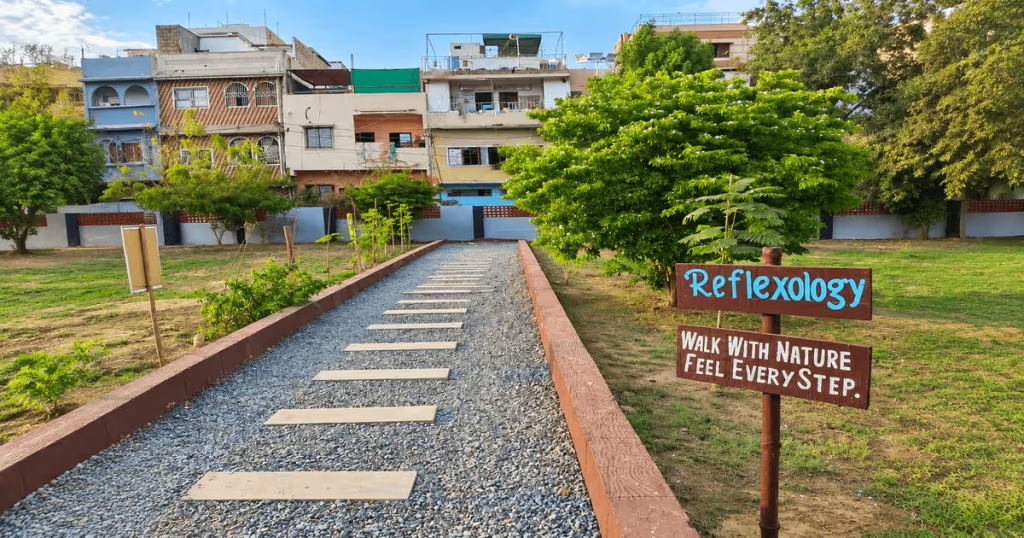
Bioswales are drainage channels. Permeable pathways let rain pass into the soil instead of running off. The park also has a pollinator patch, a wildlife corner, and a space for community lessons.
What the Reports Do Not Say Yet?
The reports leave some gaps. Neither Tribune nor Dawn publishes the park’s cost or funding split. Neither provides measured flood-reduction or groundwater-recharge numbers. Tribune also leaves out who maintains the park. Nonetheless, Tribune says the model could spread to other Karachi parks if the experiment works. Dawn adds that Gulberg Town’s chairman plans similar parks elsewhere in the town.
Biodiversity Conservation in Pakistan Starts With Neighborhood Parks
Biodiversity conservation in Pakistan means protecting native plants, animals, and habitats, including those in cities. Jamali Park plants native trees instead of a plain lawn. Tribune names tamarind, almond, peepal, and gulmohar. The park also keeps zones for butterflies and other wildlife.
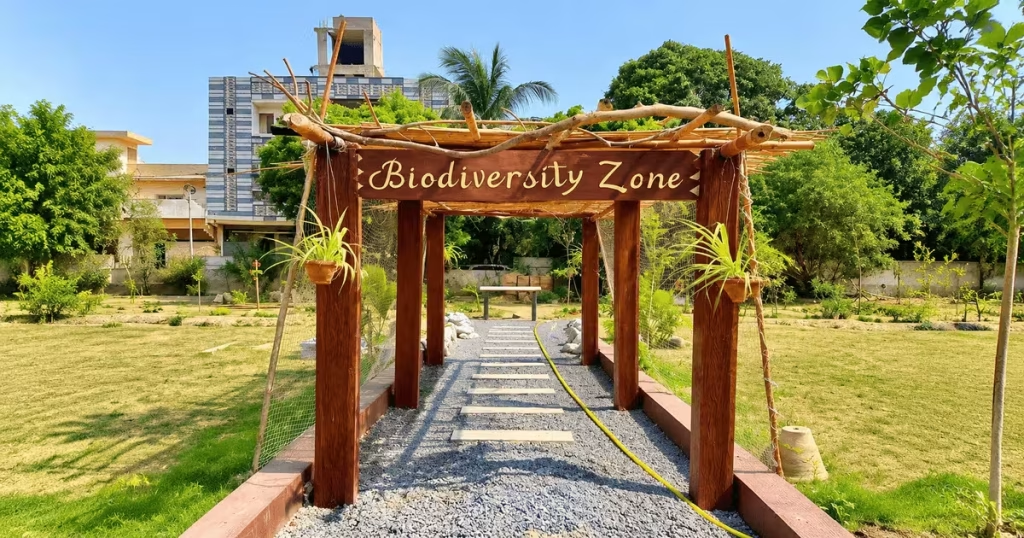
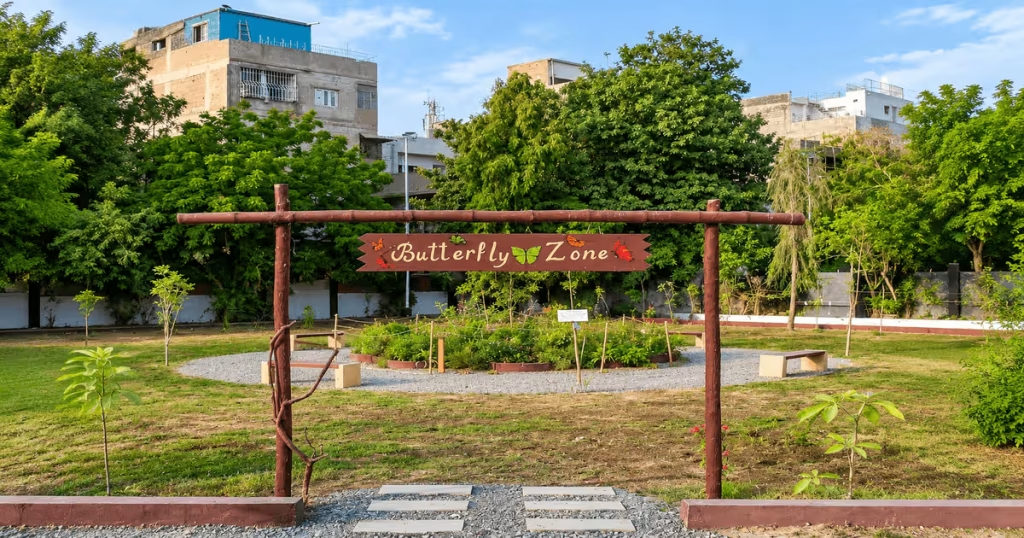
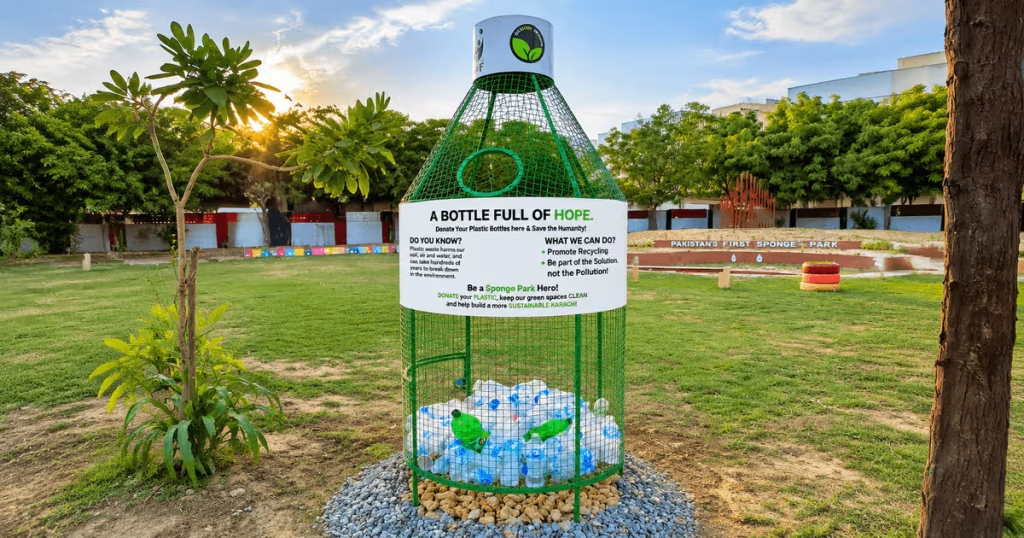
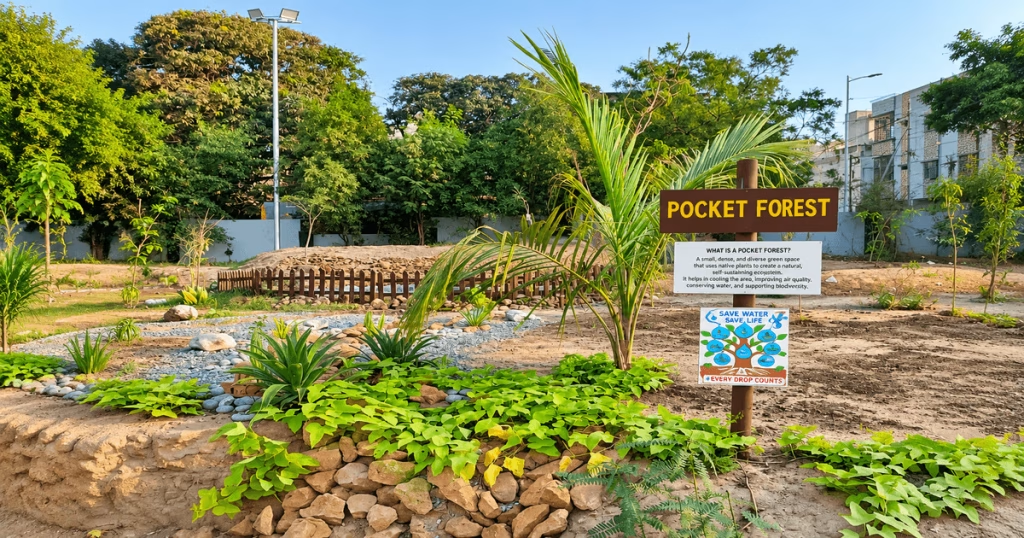
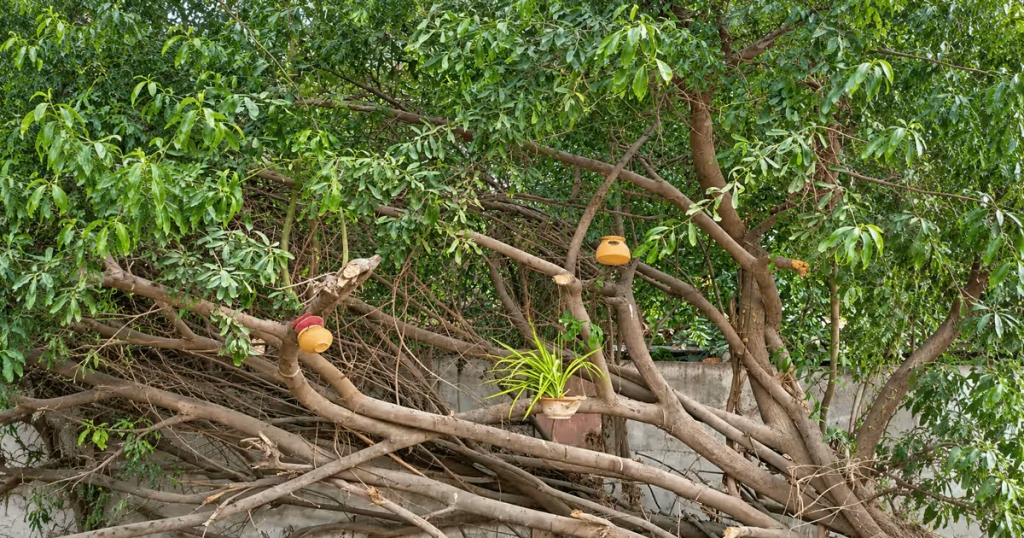
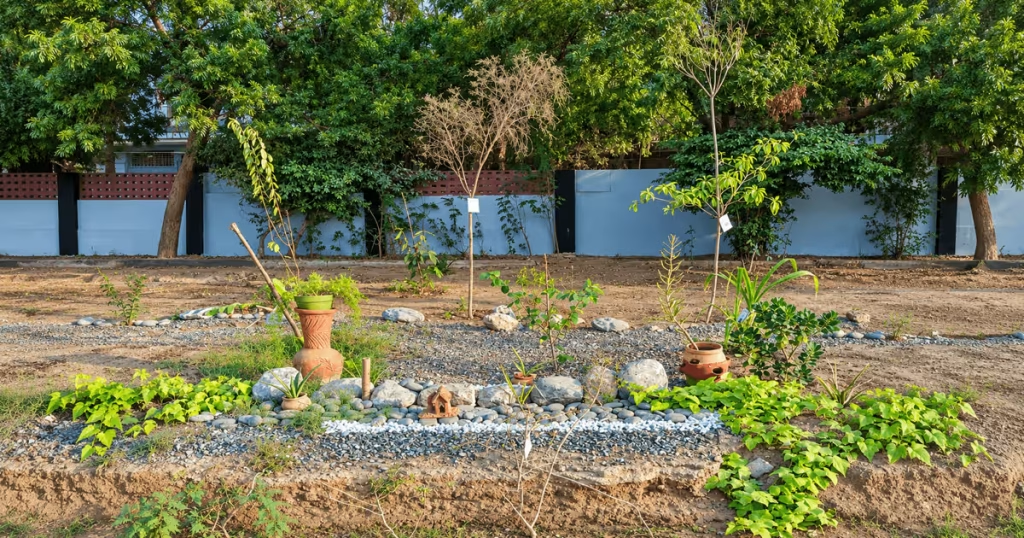
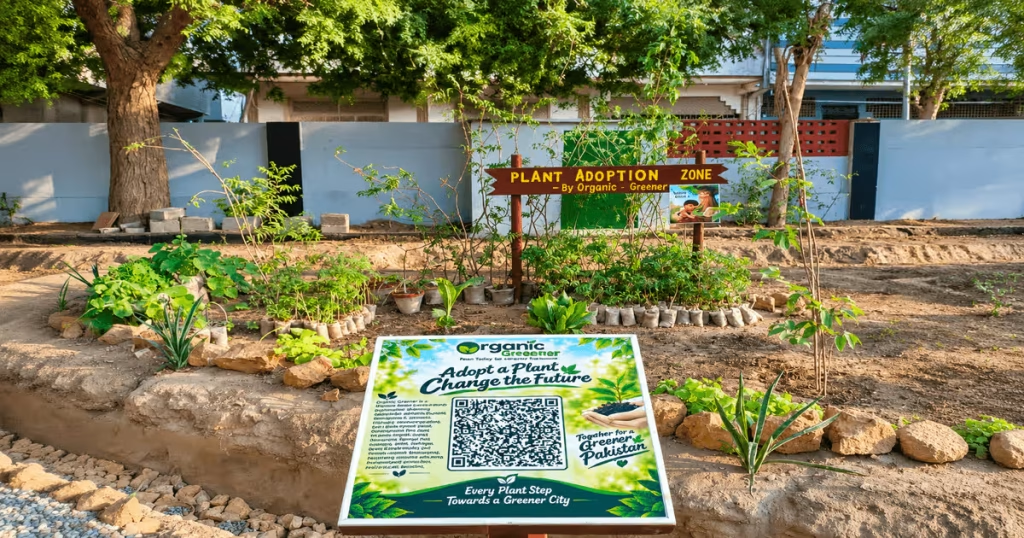
Organic Greener also mentions pocket forests and plantings that welcome pollinators, birds, and butterflies. The plantation area is especially interesting. Residents scan a barcode and take home a plant. They promise to care for it and stay in touch so that staff can track its growth. Additionally, we also covered Masood Lohar’s urban forest effort in Clifton, a related green-space story from Karachi.
How Jamali Park’s Benches Turn Waste Into Seats?
Even the benches at Jamali Park carry a message. A sticker on one bench shows the WWF and Organic Greener logos side by side. It reads “A Second Life for Wood.” The text says the bench uses recycled wood shavings. DigiKhi learned that the shavings come from bamboo waste.
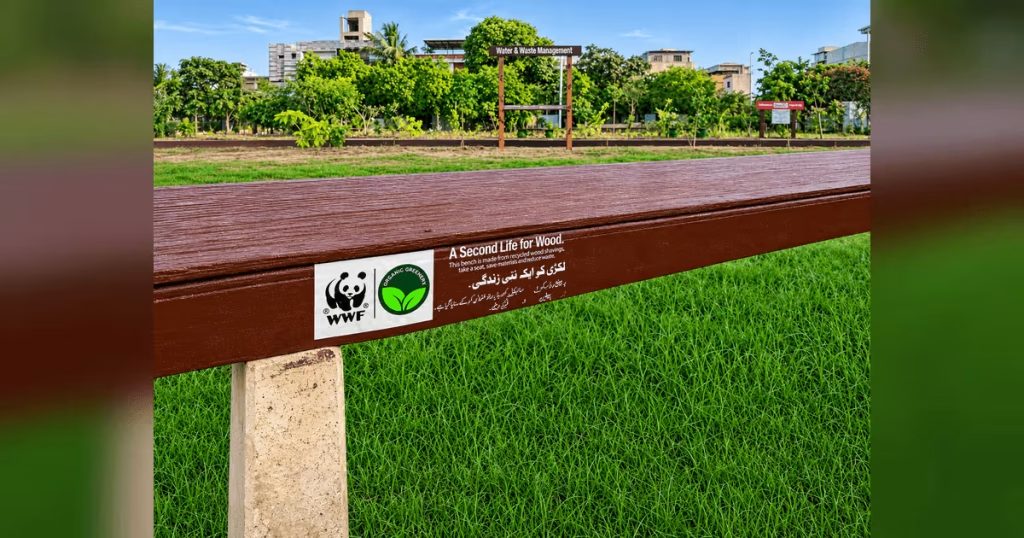
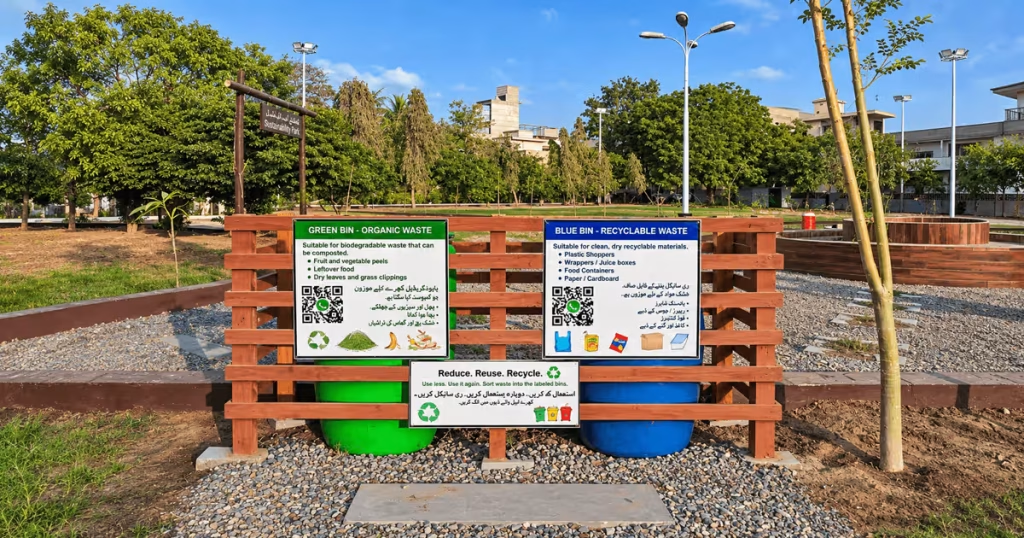
On the whole, visitors see waste turn into something useful. Organic Greener’s benches now sit in the park, and the project bought and installed them. This links the park’s water work to its waste lessons.
Why Biodiversity Conservation in Pakistan Needs Urban Green Spaces?
Dawn cites Naeem Ashraf Raja of the climate change ministry. He said the park shows that city green spaces can help meet biodiversity goals. Target 12 of the Kunming-Montreal framework asks for more urban green and blue space. It also asks for better quality and connectivity. In view of that target, a native-plant park with a pollinator zone fits the global direction. It is only one park, though.
Karachi Mein Sponge Park Ya Rain Garden Projects Kahan Dekhe Ja Sakte Hain?
Karachi mein ab ek sponge park aur kuch rainwater harvesting sites mojood hain. Sab se bara example Jamali Park hai, jo Gulberg Town mein hai. Yeh Pakistan ka pehla sponge park hai. But Tribune aur Dawn address alag likhte hain. Tribune Gulberg Block 2 batata hai. Dawn Federal B Area, Block 8 likhta hai. Isliye jaane se pehle Gulberg Town ke daftar se address confirm kar lein.
Gulberg Town mein kuch aur harvesting sites bhi hain. Express Tribune (September 2025) ne in sites ka zikr kiya. Federal B Area ke Blocks 10, 11 aur 20 mein system pehle se chal raha hai. Block 3, Hussainabad ke Khatun-e-Jannat Park mein system haal hi mein shuru hua. Yeh sites barish aur mosque ke wudu ka pani jama karti hain. Pani chhote kuwen se guzar kar bare underground reservoir mein jata hai. To explain, maqsad zameen ka pani barhana hai. Yeh pani bagh ki sinchai mein bhi kaam aata hai.
North Karachi Sector 11E mein Aman Khan Kakakhel ne park ke kunon tak pipe lagaye. Express Tribune ne July 2022 mein unka 3 million gallons ka daava likha. Yeh unka apna daava hai, aur akhbar ne tasdeeq nahi ki. On the other hand, Mayor Wahab ne 2023 mein Burns Garden ke purane kunwen dobara chalaye. Hum ne un kunon ki maujooda halat check nahi ki.
Hum ne in jagahon ke khulne ke auqat aur entry rules check nahi kiye. Hence, jaane se pehle Gulberg Town ke daftar ya park administration se poochh lein.
How Can I Set Up Rainwater Harvesting at Home in Pakistan?
A basic rainwater harvesting system has five parts. Gutters and downpipes carry roof water. A mesh screen stops leaves. A first-flush diverter drops the dirtiest water. A tank or recharge well stores the rest. Finally, a tight lid, an insect screen, and regular cleaning keep it safe. The Pakistan Council of Research in Water Resources published operational guidelines in 2022. The steps below follow its design logic.
Check Local Rules Before You Build
Rules differ by city, and they are changing. In July 2025, the federal cabinet approved Rainwater Harvesting Provisions for the Building Code of Pakistan. ProPakistani reports that the code covers new homes, businesses, and factories. APP says the rules now sit inside Pakistan Engineering Council by-laws. In light of those reports, new builders should plan for a system. I could not read the code text itself. Ask your building authority how it applies to your plot.
Other rules exist. Punjab made harvesting mandatory for many new Lahore buildings in April 2025, Daily Times reports. Moreover, Dialogue Earth says Islamabad has required it since 2010 for houses from 400 square yards. For Karachi, GIZ says Sindh aims to add rainwater harvesting to its building rules. We found no Karachi-specific rule text. Before digging any well, ask your town office or the Karachi Water and Sewerage Corporation. The Sindh Building Control Authority can also explain the code. Keep their reply in writing.
Step-by-Step Setup for Home Rainwater Harvesting
Step 1: Measure Your Roof and Check Local Rainfall
Measure your roof’s length and width in meters. Multiply them to get the catchment area. Then check recent rainfall for your city and pick a design storm. PCRWR suggests sizing storage with a high daily rainfall value. To illustrate, a 10-meter by 9.3-meter roof gives about 93 square meters. Lastly, apply a runoff coefficient. PCRWR uses 0.9 for an impervious roof and 0.8 in its flat concrete roof example.
Step 2: Fit Gutters, Downpipes, and a Mesh Screen
Fit gutters along the roof edge and slope them toward one downpipe. Common choices are PVC or galvanized iron. Put mesh over the roof outlet to keep out leaves and trash. PCRWR advises checking gutters and downpipes monthly. During the rainy season, check them daily. Also wash the roof before the first monsoon rain.
Step 3: Add a First-Flush Diverter
The first rain washes dust, bird droppings, and debris off your roof. A first-flush diverter sends that dirty water away before it reaches the tank. PCRWR describes a valve at the base of the collector pipe. Further, it says to keep the valve open for 5 to 10 minutes after the storm starts. Despite its simplicity, a manual valve fails when nobody remembers to open it, as SSWM warns.
Step 4: Choose a Storage Tank or a Recharge Well
A tank keeps water above ground for chores and gardens. A recharge well sends water down to the aquifer instead. PCRWR’s Muhammad Ashraf told Dialogue Earth that recharge wells cost less and work better than tanks. Conversely, a tank gives you water you can reach on a dry day. PCRWR also warns you to keep dirty runoff out of recharge pits.
| Feature | Storage Tank | Recharge Well | Source |
| What it does? | Keeps water above ground for chores and gardens | Sends water down to the aquifer | PCRWR, Dialogue Earth |
| Water on a dry day | You can reach it | It joins the aquifer, not your tap | PCRWR, Dialogue Earth |
| Reported price | PKR 8,000 for 1,800 liters | PKR 25,000 for a 120-foot well | Dialogue Earth, undated |
| Expert view | Needs treatment before drinking | PCRWR’s Ashraf says it costs less and works better | SSWM, Dialogue Earth |
| Main caution | Keep lids tight and clean the tank | Keep dirty runoff out of the pit | PCRWR |
Prices do not compare like for like. A tank’s size and a well’s depth differ.
Step 5: Treat and Maintain the System
Treat rainwater before you drink it. SSWM names filtration, chlorination, biosand filters, and solar disinfection as options. PCRWR advises washing the tank at the start and end of the rains. Equally, keep the lid tight and the insect screen intact. Until you treat and test the water, use it for gardens, cleaning, and laundry. Pair garden water with healthy soil, like the approach in our vermicompost story from Jhimpir.
What Size Rainwater Storage Tank Do I Need for a Family of Five?
As a planning estimate, a family of five needs a tank of about 5,000 liters. That assumes a 93-square-meter (1,000 square feet) roof and one heavy storm. PCRWR’s rooftop method multiplies maximum daily rainfall by roof area and a runoff coefficient. For this purpose, we use a 0.8 coefficient. A heavy 62-millimeter storm then gives about 4,600 liters. A year of 200 millimeters gives about 14,900 liters.
| Roof Size | Area | One 62 mm Storm | Rain at 200 mm a Year |
| 500 sq ft | 46.5 m² | about 2,300 liters | about 7,400 liters |
| 1,000 sq ft | 93 m² | about 4,600 liters | about 14,900 liters |
| 1,500 sq ft | 139.5 m² | about 6,900 liters | about 22,300 liters |
Estimates use a 0.8 runoff coefficient. Real yield drops after the first flush and overflow.
Next, match your demand. Say your family of five uses 100 liters per person daily for laundry, cleaning, and gardening. That totals 500 liters a day. That 100-liter figure is our example, not a Pakistani standard. In essence, one 4,600-liter storm covers about nine days of that use. Change the number to fit your own habits.
Pick a tank close to one big storm’s yield. For the 1,000-square-foot example, that means about 5,000 liters. A smaller tank overflows and wastes free water. Karachi’s rain often arrives in short bursts, so that a huge tank may stay mostly empty. SSWM adds that cost often decides final tank size. Besides, a recharge well can take the overflow. These are planning estimates, so ask a qualified engineer to confirm them.
How Much Does It Cost to Install a Rainwater Harvesting System in Pakistan?
Reported costs run from Rs1,500 for a DIY pit to PKR 150 million for Lahore’s pilot. No single price fits every home. Published figures come from different years, cities, and system sizes. Treat them as rough markers, not quotes. Altogether, the table below lists each figure with its source. Prices have probably changed since these reports appeared.
| System or Item | Reported Cost | Source and Year |
| DIY roof-to-pit filter system, Islamabad | about Rs 1,500 | Aaj News, 2022 (builder’s figure) |
| Park-well setup, North Karachi neighborhood | Rs 30,000 to Rs 40,000 | Express Tribune, 2022 (organizer’s claim) |
| Home system starting price, Pakistani installer | PKR 30,000 | Installer’s website, checked November 2026 |
| 1,800-liter tank | PKR 8,000 | Dialogue Earth, undated |
| 120-foot recharge well | PKR 25,000 | Dialogue Earth, undated |
| Full roof harvesting and recharge system, Rawalpindi | PKR 150,000 | Dialogue Earth, undated |
| Lawrence Road pilot with 6.4 million-liter tank, Lahore | PKR 150 million | Dialogue Earth, undated |
Prices come from reports of different ages. Get current written quotes before you budget.
Savings depend on your water source. Islamabad professor Zafar Iqbal told Aaj News his pit saved about Rs10,000 in tanker costs. He paid about Rs5,000 for a tanker for one week’s supply. Although that saving is his own estimate, we couldn’t verify it. Treat it as one example.
Ways to Keep Rainwater Harvesting Costs Down
Use what you already have. Existing gutters, a sturdy roof, and a nearby soak area cut material costs. SSWM says practitioners favor simple systems that people can fix easily. A recharge well may cost less than a large tank, as Ashraf argued. Accordingly, ask at least three contractors for itemized quotes. Compare what each includes, from the diverter to the tank lid.
Are There Subsidies for Rainwater Harvesting in Pakistan?
We found no household subsidy for rainwater harvesting in Pakistan. Business Recorder says uptake still rests mostly on pilots and donor-funded projects. An SDPI writer in Pakistan Observer urges financial aid, including subsidies and low-interest loans. To sum up, budget as if you will pay the full cost. Check with your town office; programs can change.
Which Companies Install Rainwater Harvesting Systems in Karachi?
Public websites show two firms offering rainwater harvesting work: Abamet Pakistan and Energy Alternatives. We searched public websites in November 2026. This list is not an endorsement, and we have not tested anyone’s work. Each firm describes itself on its own site. Verify every claim before you sign a contract.
- Abamet Pakistan lists a rainwater harvesting system and gives a Gulshan-e-Iqbal, Karachi address.
- Energy Alternatives lists design, installation, and recharge pits for clients across Pakistan.
- Organic Greener is also providing rainwater harvesting systems and designed Jamali Sponge Park in Gulberg Town, Karachi.
Some groups advise rather than install. WWF-Pakistan lists rainwater harvesting and recharge wells in its Karachi water program. PCRWR publishes operational guidelines that any installer can follow. Another useful contact is the Gulberg Town Municipal Corporation, a Jamali Park partner.
How to Vet an Installer?
Ask for proof before you pay. Ask whether the firm holds Pakistan Engineering Council registration, and check the number yourself. Request addresses of finished projects and visit one. Insist on an itemized quote that names the first-flush diverter, mesh screens, and tank lid. Eventually, you will want a written maintenance plan too. Keep every receipt and warranty.
Where Can I Buy a Rooftop Rainwater Collection Kit in Pakistan?
We found no ready-made rooftop kit at a Pakistani retailer in our November 2026 search. Local stores do sell the parts. WaterTank.pk lists water tanks, PVC pipes, fittings, and valves online. Energy Alternatives offers installed systems rather than boxed kits, according to its site. In brief, you will likely build your own kit or hire an installer. Check stock and prices with sellers before you order.
Parts Checklist for a DIY Kit
• Gutters and brackets that fit your roof edge.
• PVC downpipe, elbows, and couplings.
• Mesh screen for the roof outlet.
• First-flush diverter with a valve at the base of the collector pipe.
• Storage tank with a tight lid, insect screen, and overflow pipe.
• Tap near the tank base.
• Filter or disinfection step before any drinking use.
What Is the Cost of Eco-Friendly Drainage Solutions for a Community Space Project?
Neither Tribune nor Dawn publishes Jamali Park’s budget, so local park costs remain unknown. US data gives a rough scale. Chicago’s water department puts a typical rain garden at $3 to $4 per square foot. Costs vary with soil and plants. Comparatively, fuller bioinfiltration systems run $10 to $40 per square foot. Those prices depend on plants, control structures, curbing, and underdrains.
| Practice | US Cost per Square Foot | Source |
| Simple rain garden, average | $3 to $4 | City of Chicago |
| Bioinfiltration with underdrains and curbing | $10 to $40 | City of Chicago |
| Rain garden, RSMeans 2020 basis | $14.40 upfront, $1.55 yearly upkeep | Headwaters Economics, 2022 |
| Rain garden, regional estimate | $10 to $20 or more | GBNRTC |
| Permeable concrete or asphalt | $6 to $15 | GBNRTC |
| Permeable pavers | $8 to $40 | GBNRTC |
US prices only. Pakistani costs will differ with labor, materials, and soil.
To scale this, a 1,000-square-foot rain garden costs $3,000 to $4,000 at Chicago’s average. At the Headwaters figure, it costs $14,400 upfront. In truth, location changes price. A CH2M expert said a city hall garden costs more than a highway median garden.
Budgeting Urban Flooding Solutions for Your Neighborhood
Timing also cuts the cost of urban flooding solutions. The Water Network reports cost cuts of 30 to 60 percent. Those savings come from adding green work to planned road, utility, or roof projects. Chiefly, that means asking your council what work it already plans. Dialogue Earth reports a 120-foot recharge well at PKR 25,000. Get local quotes for soil tests, plants, and labor, then compare.
What Are the Downsides of Rainwater Harvesting?
Rainwater harvesting helps, yet it has limits. Five problems basically come up again and again. They are rain supply, cost and upkeep, water quality, tank trade-offs, and sponge park limits. Knowing them protects your money and your health.
Rain Is Unreliable
SSWM lists supply limits first. Your system depends on rainfall, roof size, and tank size. A long drought can leave your tank short. The 2026 monsoon shows the risk, with Karachi’s rain 92 percent below normal. Evidently, a tank cannot fill from rain that never falls.
Upfront Costs and Neglected Upkeep
SSWM says you pay most of the cost up front. It also warns that people often neglect upkeep. A 2023 study of Lahore public institutions lists several barriers. They include high setup costs, limited funding, and weak public support. On the positive side, a simple design lowers both the bill and the maintenance burden.
Water Quality and Mosquito Risks
Roof water can carry dust, bird droppings, insects, and air pollution into your tank. SSWM advises tight lids and mosquito-proof screens on every opening. It also advises treatment before drinking. Explicitly, the 2023 Lahore study notes that poor installation can cause leaks and pollution.
Tanks, Recharge Wells, and Public Pushback
Tanks need treatment, pumping, and piping. Ashraf argues that recharge wells work better. Public support matters too. Dialogue Earth reports that a Lahore pilot ended up in court over environmental worries. Only if residents trust the plan will a project move ahead smoothly.
Sponge Parks Are Not a Quick Fix
Citizen Matters says sponge parks need planning around local soil and water. They also need regular upkeep, like clearing silt, tending plants, and removing litter. Clay or rock under the site can rule it out. Small projects like Jamali Park also lack public flood data yet. In short, treat sponge parks as one tool among several.
Conclusion: Rainwater Harvesting, Sponge Parks, and Smarter Cities
Karachi’s water story has two extremes. Heavy bursts flood streets, and dry years drain tanks. Rainwater harvesting addresses both at the roof and park scales. In conclusion, Jamali Park gives Karachi its first working model of that idea. Credit for the park goes to Gulberg Town, WWF-Pakistan, and Organic Greener. Its filters, rain gardens, and native plants add one more layer to urban flooding solutions. It also tests how biodiversity conservation in Pakistan works at city scale. The next step is data on cost, flood results, water quality, and upkeep.
DigiKhi will keep tracking this sponge park and similar projects. We want to hear how your home system works. By all means, share your results with our team. Check every price and rule locally before you build. For more updates, Latest News, and Digital Marketing Services, email us at contact@digikhi.com. Or visit our website (https://www.digikhi.com).
Sources
Organic Greener on LinkedIn: Inauguration of Pakistan’s First Sponge Park (13 November 2026). https://www.linkedin.com/posts/organicgreener_organicgreener-spongepark-wwfpakistan-activity-7526981717497229312-BL2X
2. ProPakistani: Rainwater harvesting will now be mandatory for all new buildings (30 July 2025). https://propakistani.pk/2025/07/30/rainwater-harvesting-will-now-be-mandatory-for-all-new-buildings/
3. APP: Green Building Code to secure Pakistan’s water future. https://www.app.com.pk/?p=1041904
4. Daily Times: Rainwater harvesting system required for new constructions in Lahore (17 April 2025). https://dailytimes.com.pk/1288310/rainwater-harvesting-system-required-for-new-constructions-in-lahore/
5. GIZ: Sindh Green Buildings Initiative. https://www.giz.de/en/regions/asia/pakistan/news/sindh-green-buildings-initiative-pathway-energy-efficient-and-climate
6. Business Recorder: Rainwater harvesting feature. https://www.brecorder.com/news/40372965
7. Pakistan Observer: Rainwater Harvesting, a Vital Alternative (SDPI author). https://pakobserver.net/rainwater-harvesting-a-vital-alternative
8. The Express Tribune: Karachi inaugurates Pakistan’s first sponge park. https://tribune.com.pk/story/2639920/karachi-inaugurates-pakistans-first-sponge-park-to-conserve-rainwater
9. The Express Tribune: Metro gets a sponge for rainwater. https://tribune.com.pk/story/2639870/metro-gets-a-sponge-for-rainwater
10. Dawn: Country’s first sponge park to save rainwater, cut urban flooding risk in Karachi. https://www.dawn.com/news/2044415/countrys-first-sponge-park-to-save-rainwater-cut-urban-flooding-risk-in-karachi
11. The Express Tribune: Gulberg Town harvests rainwater (September 2025). https://tribune.com.pk/story/2565912/gulberg-town-harvests-rainwater
12. The Express Tribune: Sindh records country’s biggest rainfall deficit (1 October 2026). https://tribune.com.pk/story/2632341/sindh-records-countrys-biggest-rainfall-deficit
13. The Express Tribune: Karachi receives a third of its annual rainfall in three hours (2012). https://tribune.com.pk/story/432751/unusual-pattern-karachi-receives-third-of-its-annual-rainfall-in-three-hours
14. The Express Tribune: Aman Khan Kakakhel and rainwater harvesting in Karachi (20 July 2022). https://tribune.com.pk/story/2366820/entertainment
15. Geo News: Murtaza Wahab suggests reviving British-era wells (9 July 2023). https://www.geo.tv/latest/498097-murtaza-wahab-suggests-reviving-british-era-wells-to-prevent-urban-flooding-in-karachi
16. Aaj News: How to build a Rs1,500 solution to save Rs10,000 on water tankers (29 June 2022). https://english.aaj.tv/news/30290802/how-to-build-a-rs1500-solution-to-save-rs10000-on-water-tankers
17. Dialogue Earth: Can rainwater harvesting fix Pakistan’s urban flooding problem?. https://dialogue.earth/en/water/can-rainwater-harvesting-fix-pakistans-urban-flooding-problem/
18. Business Recorder: Pakistan water scarcity report (18 September 2023). https://www.brecorder.com/news/amp/40263670
19. WWF-Pakistan: Building Water-Sensitive Societies. https://www.wwfpak.org/our_work_/water_/building_water-sensitive_societies/
20. PCRWR: Operational Guidelines for Rainwater Harvesting Techniques (November 2022). https://unhabitat.org.pk/wp-content/uploads/2023/09/Operational-Guidelines-for-Rainwater-Harvesting-Techniues.pdf
21. SSWM: Rainwater harvesting (rural). https://www.sswm.info/water-nutrient-cycle/water-sources/hardwares/precipitation-harvesting/rainwater-harvesting-(rural)
22. MDPI CivilEng: Rainwater harvesting case study of public institutions in Lahore (2023). https://www.mdpi.com/2673-4109/4/2/37
23. Citizen Matters: Understanding sponge parks (August 2025). https://citizenmatters.in/understanding-sponge-parks-why-are-indian-cities-opting-for-it/
24. CBD: World Habitat Day 2024 and Target 12. https://cbd.int/article/world-habitat-day-2024
25. InforMEA: Kunming-Montreal GBF Target 12. https://informea.org/ar/goals/kunming-montreal-global-biodiversity-framework/target-12-enhance-green-spaces-and-urban
26. City of Chicago: Bioinfiltration and rain gardens. https://www.chicago.gov/city/en/depts/water/supp_info/conservation/green_design/bioinfiltration_raingardens.html
27. Headwaters Economics: Green infrastructure maintenance costs (2022). https://headwaterseconomics.org/wp-content/uploads/2022HE-GreenInfrastructure.pdf
28. GBNRTC: Green infrastructure costs. https://www.gbnrtc.org/sema/green-infrastructure
29. Water Environment Federation: Green infrastructure cost drivers. https://dev-stormwater.wef.org/?p=6672
30. The Water Network: The real cost of green infrastructure. https://thewaternetwork.com/article-FfV/the-real-cost-of-green-infrastructure-4nQfDWp75KuIxACfih-iCg
31. Abamet Pakistan: Rainwater harvesting system. https://www.abamet.com.pk/products-systems/rainwater-harvesting-system/
32. Energy Alternatives: Rainwater harvesting in Pakistan. https://energyalternatives.com.pk/rainwater-harvesting-in-pakistan
33. WaterTank.pk: Dura Flow products. https://watertank.pk/brand/dura-flow/
Disclaimer: This article is for general information only. It does not give engineering, legal, or financial advice. We drew facts from the sources above as of 14 November 2026. Reports differ on some details, such as the park’s exact address. Costs come from reports of different ages and places, and US prices do not predict Pakistani prices. Company names appear only because they list relevant services publicly, and DigiKhi does not endorse them. Confirm local rules, prices, and safety steps with qualified professionals and your municipal office before you build or drink treated rainwater.




Related Articles


Urban Forest Clifton Karachi: Efforts of Masood Lohar
Discover how the Clifton Urban Forest is rapidly transforming into a thriving...
